
The Illusion of Safety
As a business owner, you likely have a checklist of security protocols you check off every year. You have a firewall, your team uses unique passwords, and you probably have an antivirus program running in the background. You feel protected.
But what if the front door to your business looks completely locked, while the back door is left wide open?
In our years of managing small business cybersecurity, network infrastructure, and compliance, we consistently see companies making the same critical assumption: “If my website is live and my email sends, my system is secure.” The reality is that traditional security setups are no longer enough to stop modern cyber threats. Let’s look at two hidden gaps that put small businesses at risk every single day—and exactly how to patch them.
1. The Email Identity Trap (Why Hackers Can Spoof Your Domain)
Imagine someone printing fake stationary with your exact corporate logo, writing a fraudulent invoice, and mailing it to your clients. That is exactly what happens digitally when your domain lacks modern email authentication protocols.
Without specific cryptographic keys embedded in your Domain Name System (DNS), anyone on the internet can configure a rogue mail server to send messages that look like they came directly from your company address (e.g., billing@yourfirm.com). This is how aggressive phishing campaigns and invoice fraud happen.
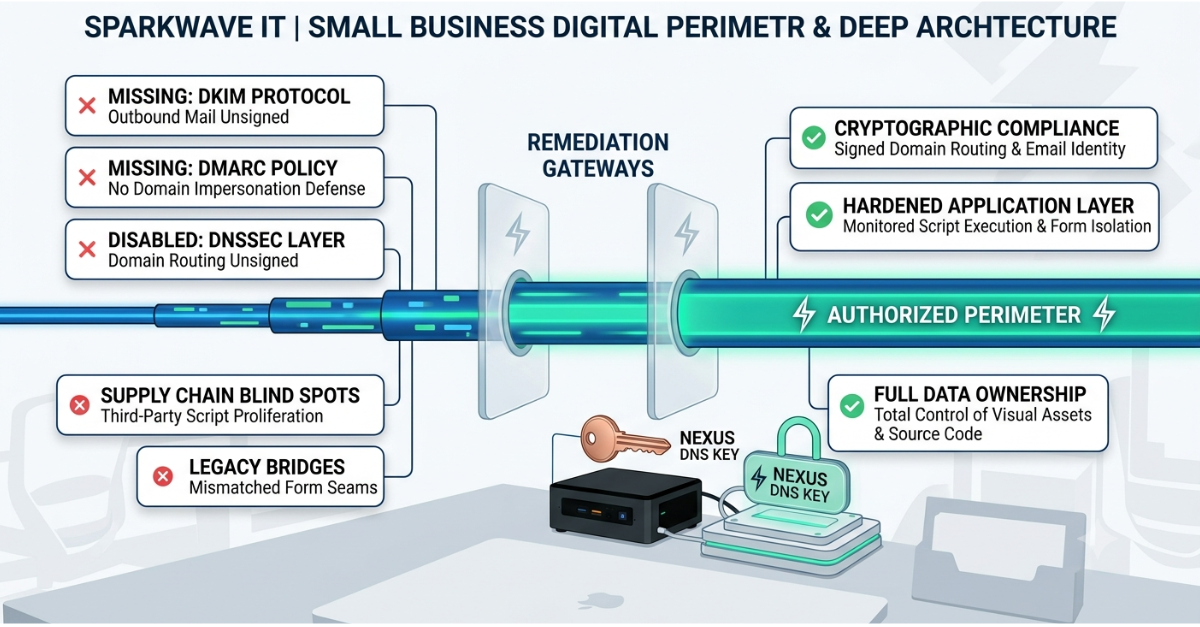
To turn the lock on your email security, your system requires three foundational protocols:
- DKIM (DomainKeys Identified Mail): This acts as a digital signature. It cryptographically signs outbound emails so the recipient’s mail server can verify that the message actually came from your business and wasn’t altered in transit.
- DMARC (Domain-based Message Authentication, Reporting, and Conformance): This is your enforcement policy. It tells global mail networks (like Gmail and Outlook) exactly what to do with an email that fails authentication—instructing them to automatically drop it or send it straight to quarantine rather than letting it hit a customer’s inbox.
- SPF (Sender Policy Framework): A strict directory listing every authorized server permitted to send mail on your behalf, cutting off unauthorized third-party impersonation.
2. Third-Party Script Proliferation (The Invisible Supply Chain Risk)
Most modern websites are built like a mosaic. To add a financing form, a tracking pixel, or a cookie compliance banner, websites pull in snippets of JavaScript code hosted on external third-party servers.
Every time a user visits your site, their web browser forces those external scripts to execute. If a malicious actor compromises just one of those outside vendors, they can quietly alter that script to inject a keylogger. Suddenly, sensitive customer data, form inputs, or credit applications are intercepted before they ever touch your actual secure server.
Securing this vector requires deploying a strict Content Security Policy (CSP). A CSP is a specialized layer of code added to your website headers that restricts exactly which external domains are allowed to execute scripts or transmit data within a visitor’s browser session.
Building a Standardized Compliance Posture
True network security isn’t about buying a flashier software subscription; it’s about standardizing your underlying infrastructure compliance. Ensuring your digital perimeter is locked down protects your client data, preserves your brand reputation, and guarantees operational continuity.
If you aren’t sure whether your domain routing paths are fully signed or if your web forms are properly isolated, it’s time for a professional baseline diagnostic. Taking 45 minutes to audit your DNS structure and application perimeters today saves thousands of dollars in liability tomorrow.
Business Continuity Checklist: A firewall won’t stop a hacker from spoofing an unauthorized invoice if your DNS settings are left exposed. Take the guesswork out of your network security configuration today.
🛒 Click Here to Request Your Professional Infrastructure Audit